
人才详细信息

姓名:白 玲
性别:
学历:博士
专家类别:研究员/国家高层次人才
电话:010-84097035
传真:010-84097079
电子邮箱:bailing@itpcas.ac.cn
职称:研究员/国家高层次人才
通讯地址:北京市朝阳区林萃路16号院3号楼

简介

个人简历

2012.03 – 今 中国科学院青藏高原研究所  研究员

2017.07 – 2018.12 美国斯坦福大学地球物理系 Blaustein  访问教授

2009.10 – 2012.03 美国密歇根大学地球环境科学系  博士后

2007.04 – 2009.09 日东东京大学地震研究所 JSPS外国人  特别研究员

2003.10 – 2007.03 日本京都大学防灾研究所  博士

1999.09 – 2003.09 中国地震局地球物理研究所  硕博连读

讲授课程

2016-今 中国科学院大学《Plate tectonics and evolution of Tibetan Plateau》

2020-今 中国科学院大学《地表过程与地貌学》

科学传播

2025年 新华网 《我国科学家发现控制喜马拉雅东部地震活动关键机制》

2023年 中科院之声 《土耳其双震发生在断裂带活动空区》

2022年 中国科学院 格致论道《聆听来自高原的地震波》

2021年 中央电视台 透视新科技《探寻珠峰“身高”的奥秘》

2021年 北京新闻广播 编辑部的故事 《走近地球之巅》

2020年 新华网《问道世界屋脊 感知世界缤纷》

2020年 地震微科普《揭秘喜马拉雅大地震》

2019年 中央电视台 新闻直播间《第二次青藏科考在雅鲁藏布大峡谷建地震台站》

研究方向

地震震源物理,高原深部结构

职务

社会任职

2022—今 中国科学院大学 岗位教授

2025—今 中国地震学会 理事

2020—今 中国青藏高原研究会 理事

2024—今 学术期刊《地震学报》 编委

2020—今 学术期刊《大地测量与地球动力学》 编委2020—今 学术期刊《Earthquake Science》 编委

承担项目

1.国家自然科学基金重点项目:南迦巴瓦碰撞区深部表层过程耦合及地震与冰崩灾害效应(2022-2026),主持

2.中国科学院王宽诚率先人才计划卢嘉锡国际合作团队:造山带壳幔结构及其浅部响应(2020-2022),主持

3.国家自然科学基金国际(地区)合作与交流项目2015年尼泊尔地震相关地质灾害的地震学成因(2018-2020),主持

4.日本京都大学防灾研究所国际合作项目2015年尼泊尔地震的震源过程以及结构特征(2017-2019),主持

5.  中国科学院人才计划:青藏高原地区地震发生机理以及地球内部结构(2014-2017),主持

6.  国家自然科学面上基金:采用SS前驱波研究青藏高原地区地球内部结构(2013-2016),主持

7.日本学术振兴会:中国东北地区的地震学研究(2007-2009),主持

8.日本科学协会笹川研究基金:2004年日本纪伊半岛地震的震源参数及其构造意义(2004-2005),主持

获奖及荣誉

2023年 国家自然科学二等奖

2022Wiley威力中国开放科学高贡献作者

2021年 国家高层次人才计划

2020年 中国科学院杰出科技成就奖(突出贡献者)

2018年 中国青藏高原研究会青藏高原青年科技奖

2016年 中国地球物理学会傅承义青年科技奖

2014年 中国科学院人才计划

代表论著

出版论著

  1. 白玲,沈旭章,丁志峰,金胜,董浩,高锐,丁林. 2025. 南迦巴瓦地区岩石圈精细结构与浅部响应. 科学出版社. ISBN 978-7-03-080674-1.期刊论文(5篇代表性论文)
  2. Bai, L., Li H., Chen, Z., Zhan, H., Li, G., Mori, J. Ding, L., 2025. Low-angle subduction of the Indian plate and megathrust geometry below the eastern Himalaya, National Science Review 12. Nwaf460.
  3. Bai, L., Klemperer, S.L. Mori, J., Karplus, M.S., Ding, L., Liu, H., Li, G., Song, B., Dhakal, S., 2019. Lateral variation of the Main Himalayan Thrust controls the rupture length of the 2015 Gorkha earthquake in Nepal. Science Advances 5, eaav0723.
  4. Bai, L., Jiang, Y., Mori, J., 2023. Source processes associated with the 2021 glacier collapse in the Yarlung Tsangpo Grand Canyon, southeastern Tibetan Plateau. Landslides 20: 421-426.
  5. Bai, L., Ritsema, J., 2013. The effect of large-scale shear-velocity heterogeneity on SS precursor amplitudes. Geophysical Research Letters 40: 1-5.
  6. Bai, L., Bergman, E.A., Engdahl, E.R., Kawasaki, I., 2007. The 2004 earthquake offshore of the Kii peninsula, Japan: Hypocentral relocation, source mechanism and tectonic implications. Physics of the Earth and Planetary Interiors 165: 47-55.

期刊论文(其他论文)

  1. Dhakal, S., Bai, L.*, Song, B., Li, G., Rahman, M.M., Su, H., Chen, Z., Wang, S., Li, H., Li, L., 2026. Source parameters of the 2023 ML 6.4 Jajarkot earthquake in the western Nepal seismic gap zone. Earthquake Science 39: 273-285.
  2. Wibowo, B.A., Li, H., Rahayu, A.N., Bai, L.*, Rohadi, S., Widyadharma, P.H., Arimuko, A., Adi, S.P., 2026. Source process of the 2021 Mw6.6 outer rise earthquake off the west coast of northern Sumatra. Reviews of Geophysics and Planetary Physics 57: 51-61
  3. Rahman, M.M., Bai, L.*, Li, H., Liu, C., 2025. Probabilistic seismic hazard map for Bangladesh including the smoothed background seismicity and local site effects. Pure and Applied Geophysics,https://doi.org/10.1007/s00024-025-03894-w.
  4. Wang, S., Bai, L.*, Liu, C., 2025. Coseismic Rupture and Postseismic Afterslip of the 2020 Nima Mw6.4 Earthquake. Remote Sensing 17, 1389. https://doi.org/10.3390/rs17081389.
  5. Wibowo, B.A, Bai, L.*, Rohadi, S., Sahara, D.P., Chen, Z., Karyono, K., Setiawan, Y., Widyadharma, P.H., Arimuko, A., Rahayu, A.N., Adi, S.P., Karnawati, D., 2025. Slab morphology and associated seismic and volcanic activities beneath Sulawesi Island, Indonesia. Journal of Volcanology and Geothermal Research 465, 108352.
  6. Bai, L., 2025. Temporal Variation of Large Outer Rise Earthquakes at the Circum-Pacific Subduction Zones. H. Tatano et al. (Eds.): GSRIDRR 2023, DRRGADRIBS, 444-453.
  7. Liu, C., Li, H., Zhan, H., Wang, S., Bai, L., 2025. Coseismic and Postseismic Deformations of the 2023 Turkey Earthquake Doublet. Remote Sensing 17, 3573.
  8. Hossain, M.A., Rahman, M.M., Hasan, S.S., Mahmud, A., Bai, L., 2025. Analysis and forecasting of meteorological drought using PROPHET and SARIMA models deploying machine learning technique for southwestern region of Bangladesh. Environmental and Sustainability Indicators 27, 100761.
  9. Zhan, H., Bai, L.*, Wibowo, B. A., Liu, C., Oike, K., Ishikawa, Y., 2024. The 2023 Turkey earthquake doublet: Earthquake relocation, seismic tomography, and stress field inversion. Earth Planetary Physics, 8(3): 535-548.
  10. Ishikawa, Y., Bai, L., 2024. The 2024 Mj 7.6 Noto Peninsula, Japan earthquake caused by the fluid flow in the crust, Earthquake Research Advances https://doi.org/10.1016/j.eqrea.2024.100292.
  11. Rahman, M.M., Bai, L.*, 2024. Seismic hazard maps of the eastern Himalaya syntaxis by integrating the surface topography and site effects. Pure and Applied Geophysics 181: 409-432.
  12. Bai, L., Liu, C., Ji, Y. Zhu, W., 2023. Infrasound waves and sulfur dioxide emissions caused by the 2022 Hunga volcanic eruption, Tonga. Frontiers in Earth Science, 11:1144496.
  13. Rahman, M.M., Haque, T., Mahmud, A., Amin, M.A, Hossain, M.S., Hasan, M.Y., Shaibur, M.R., Hossain, S., Hossain, M.A., Bai, L.*, 2023. Drinking water quality assessment based on index values incorporating WHO guidelines and Bangladesh standards. Physics and Chemistry of the Earth 129, 103353.
  14. Li, G., Zhou, Y., Bai, L., Gao, Y., Li, Y., 2023. Upper mantle melt caused by a subducted slab in the Indian-Eurasian continental subduction zone. Communications Nature and Environment 4: 455.
  15. Rahman, M.M., Mahmud, A., Amin, M.A., Hossain, M.S., Bai, L., Shaibur, M.R., Rahman, M.A., Khan, A.S., 2023. Hydrogeochemical facies analysis of groundwater at parts of southwestern Bangladesh: a case study. Arabian Journal of Geoscience, 16: 644.
  16. Li., G., Bai, L.*, Zhang, H., Xu, Q., Zhou, Y., Gao, Y., 2022. Velocity anomalies around the mantle transition zone beneath the Qiangtang terrane, central Tibetan plateau from triplicated P waveforms. Earth and Space Science 9, e2021EA002060.
  17. Li, G., Zhou, Y., Ding, L., Gao, Y., Bai, L., Zhang, H., Hu, L., Pan, Z., Ju, C., Zhang, D., 2022. A partial molten low-velocity layer atop the mantle transition zone beneath the western Junggar: implication for the formation of subduction-induced sub-slab mantle plume. Geochemistry, Geophysics, Geosystems 23, e2021GC010150. 
  18. Bai, L., Fang, L., 2021. Preface to the special issue on M6.4 Yangbi, Yunnan and M7.4 Maduo, Qinghai earthquakes. Earthquake Science 34: 387-389.
  19. Liu, C., Bai, L. *, Hong, S., Dong, Y., Jiang, Y., Li, H., Zhan, H., Chen, Z., 2021. Coseismic deformation of the 2021 Mw7.4 Maduo earthquake from joint inversion of InSAR, GPS and teleseismic data. Earthquake Science 34: 436-446.
  20. An, B., Wang, W., Yang, W., Wu, G., Guo, Y., Zhu, H., Gao, Y., Bai, L., Zhang, F., Zeng C., Wang, L., Zhou, J., Li, X., Li, J., Zhao, Z., Chen Y., Liu, J., Li, J., Wang, Z., Chen, W., Yao, T., 2021. Process, mechanisms, and early warning of glacier collapse-induced river blocking disasters in the Yarlung Tsangpo Grand Canyon, southeastern Tibetan Plateau, Science of the Total Environment https://doi.org/10.1016/j.scitotenv.2021.151652.
  21. Bai, L., Su, H., Zhou, Y., 2021. A reappraisal of the 2005 Kashmir earthquake in the northwestern Himalaya syntaxis. Acta Geologica Sinica 95: 22-24.
  22. Li, G., Bai, L.*, Ritsema, J. 2020. Lateral variation of shear-wave velocity in the D” layer beneath the Indian-Eurasian plate collision zone. Geophysical Research Letters 47, e2019GL086856.
  23. Jagirani, S.S., Bai, L.*, Jagirani, M.D., et al., 2020. Sedimentological Study of Manchar Formation, Kari Buthi Section, Northern Laki Range. Southern Indus Basin, Pakistan. International Research Journal of Earth Sciences 8: 9-21.
  24. Dhakal, S. Bai, L.*, Neupane, B., Li, L., Song, B., 2019. Review of earthquake activity and faulting structure in Nepal Himalaya. Bulletin Nepal Geological Society 36: 259-266.
  25. Li, G., Li, Y.E., Zhang, H., Bai, L., Ding, L., Li, W., Cui, Q., Zhou, Y., 2019. Detection of a thick and weak low-velocity layer atop the mantle transition zone beneath the northeastern South China Sea from triplicated P-wave waveform modeling. Bulletin Seismological Society America 109(4): 1181-1193.
  26. Rahman, M.M. Bai, L.*, 2018. Probabilistic seismic hazard assessment of Nepal using multiple seismic source models. Earth Planetary Physics 2: 327-341.
  27. Rahman, M.M. Bai, L.*, Khan, N.G., Li, G., 2018. Probabilistic Seismic Hazard Assessment for Himalayan-Tibetan Region from Historical and Instrumental Earthquake Catalogs. Pure and Applied Geophysics 175: 685-705.
  28. Bai, L., Li, G., Khan, N.G. Zhao, J., Ding, L., 2017. Focal depths and mechanisms of shallow earthquakes in the Himalayan-Tibetan region. Gondwana Research 41: 390-399.
  29. Khan, N.G., Bai, L.*, Zhao, J., Li, G., Rahman, M.M., Cheng, C., Yang, J., 2017. Crustal structure beneath Tien Shan orogenic belt and its adjacent regions found by multi-scale seismic data. Science China: Earth Sciences 60: 1-14.
  30. Li, G., Bai, L., Zhou, Y., Wang, X., Cui, H., 2017. Velocity structure of the mantle transition zone beneath the southeastern edge of Tibetan Plateau. Tectonophysics 721: 349-360.
  31. Bai, L., Liu, H., Ritsema, J., Mori, J., Zhang T., Ishikawa, Y., Li, G., 2016. Faulting structure above the Main Himalayan Thrust as shown by relocated aftershocks of the 2015 Mw 7.8 Gorkha, Nepal earthquake. Geophysical Research Letters 43: 637-642.
  32. Bai, L., Zhang, T., 2015. Complex deformation pattern of the Pamir-Hindu Kush region inferred from multi-scale double-difference earthquake relocations. Tectonophysics 638: 177-184.
  33. Pei, S., Liu, H., Bai, L., Liu, Y., Sun, Q., 2016. High-resolution seismic tomography of the 2015 Mw7.8 Gorkha earthquake, Nepal: Evidence for the crustal tearing of the Himalayan Rift. Geophysical Research Letters 43: 9045-9052.
  34. Bai, L., Medina Luna, L., Hetland, E.A., Ritsema, J., 2014. Focal depths and mechanisms of Tohoku-Oki aftershocks from teleseismic P wave modeling. Earthquake Science27: 1-13.
  35. Bai, L., Ritsema, J., 2013. The effect of large-scale shear-velocity heterogeneity on SS precursor amplitudes. Geophysical Research Letters 40: 1-5.
  36. Bai, L., Zhao, J., Wu, J., 2013. Fault Heterogeneities of Moderately Large Earthquakes at Eastern Tibetan Plateau. Acta Geologica Sinica87: 331-333.
  37. Bai, L., Zhang, Y., Ritsema, J., 2012. An analysis of SS precursors using 3D spectral-element seismograms. Geophysical Journal International 188: 293-300.
  38. Bai, L., Ritsema, J., Zhao, J., 2012. Focal depth estimates of earthquakes in the Himalayan-Tibetan region from teleseismic waveform modeling. Earthquake Science25:459-468.
  39. Bai, L., Tian, X., Ritsema, J., 2010. Crustal structure beneath the Indochina peninsula from teleseismic receiver functions.Geophysical Research Letters 37, L24308.
  40. Bai, L., Kawakatsu, H., Morita, Y., 2010. Two anisotropic layers in central orogenic belt of North China Craton. Tectonophysics 494: 138-148.
  41. Bai, L., Iidaka, T., Kawakatsu, H., Morita, Y., Dzung, N.Q., 2009. Upper mantle anisotropy beneath Indochina block and adjacent regions from shear-wave splitting analysis of Vietnam array data. Physics of the Earth and Planetary Interiors 176: 33-43.
  42. Ishikawa, Y., Bai, L., 2008. About the earthquake intensity. Earthquake letter 10: 5-6.
  43. Bai, L., 2007. The 2004 earthquake offshore of the Kii peninsula, Japan: Hypocentral relocation, source mechanism and tectonic implication. Kyoto University Ph.D Dissertation.
  44. Bai, L., Kawasaki, I., Zhang, T., Ishikawa, Y., 2006. An improved double-difference earthquake location algorithm using sP phases: Application to the foreshock and aftershock sequences of the 2004 earthquake offshore of the Kii peninsula, Japan (Mw 7.5), Earth Planets Space 58: 823-830.
  45. Bai, L., Wu, Z., Zhang, T., Kawasaki, I., 2006. The effect of distribution of stations upon location error: Statistical tests based on the double-difference earthquake location algorithm and the bootstrap method. Earth Planets Space 58: e9-e12.
  46. Bai, L., Zhang, T., Zhang, H., 2003. Multiplet relative location approach and waveform correlation correction and their application.Acta Seismologica Sinica 16: 606-615.
  47. 白玲,陈治文,王绍俊. 2025. 2025年西藏定日6.8级地震:构造背景分析与震源特征探讨. 地球与行星物理论评(中英文) 56(3), 258-263
  48. 江勇,白玲*,黄兴辉,谢军. 2025. 采用地震波研究滑坡的动力学过程. 地震  45, 130-146.
  49. 江勇,白玲*,李鸿儒,陈治文,吴智超. 2025. 2000年易贡高速滑坡的动力学过程. 地球与行星物理论评(中英文) 57, 62-69.
  50. 李国辉,周元泽,白玲,高原. 2025. 中国大陆及邻区地幔过渡带上覆低速层及其动力学效应. 地球与行星物理论评(中英文)56, 1-9
  51. 詹慧丽,白玲*,陈治文,2023. 1950年西藏墨脱-察隅8.6级地震震源参数、发震构造及周边地震活动性. 地球与行星物理论评 54: 44-55.
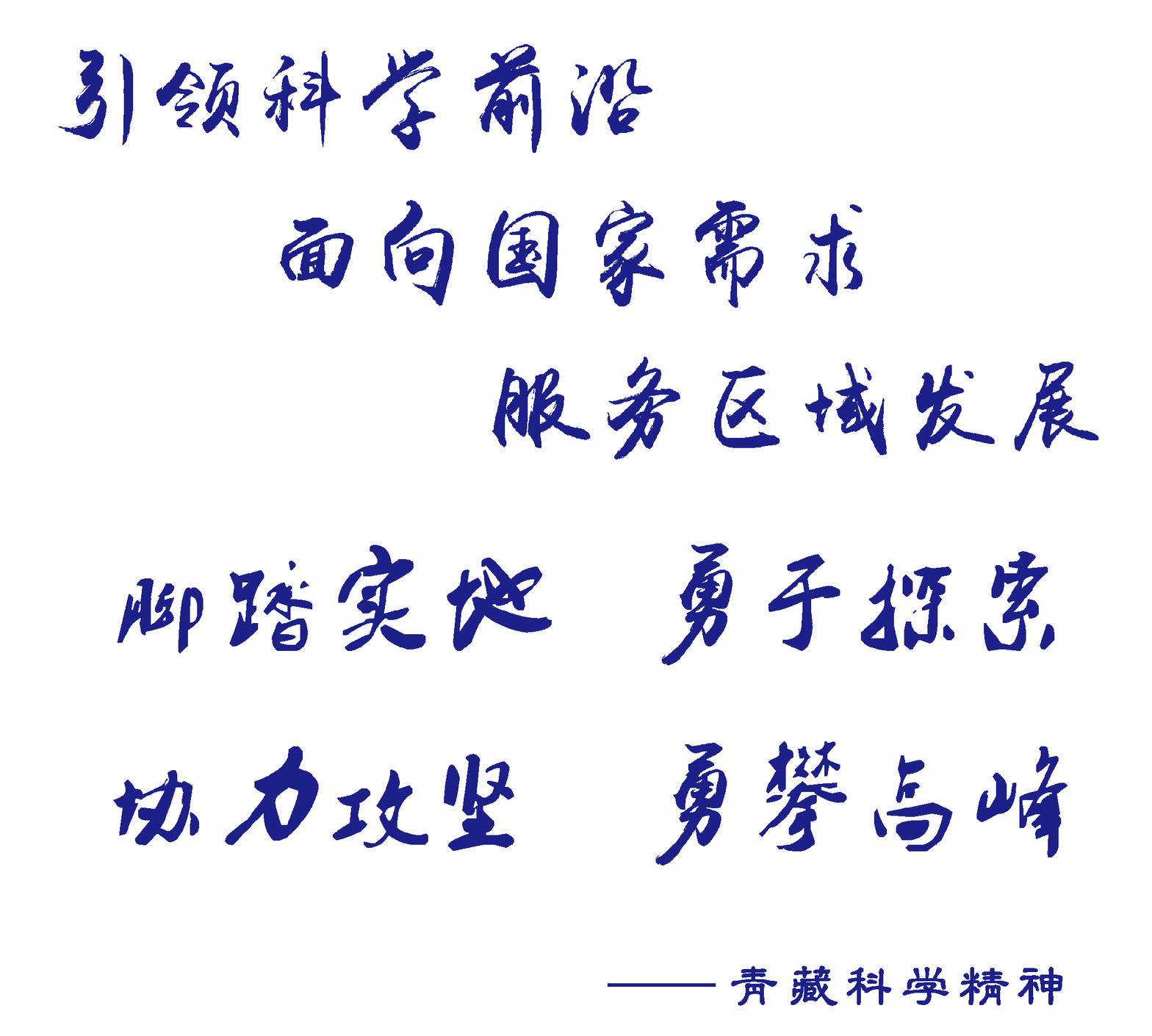
  52. 白玲,丁林,2021.探索科学前沿,服务区域发展. 科学通报,https://doi.org/10.1360/TB-2021-0555.
  53. 李鸿儒,白玲*,詹慧丽,2021. 嘉黎断裂带活动性研究进展. 地球与行星物理论评 52: 182-193.
  54. 白玲2020. 从侏罗纪时代的海底世界到现今的地球之巅——珠穆朗玛峰的前世今生. 文汇报202082
  55. 李国辉,白玲*,丁林,宋博文,江勇,2020. 2019年西藏墨脱Ms6.3级地震震源参数及其构造意义. 地球物理学报63: 1214-1223.
  56. 白玲,宋博文,李国辉,江勇,Sanjev Dhakl2019. 喜马拉雅造山带地震活动及其相关地质灾害. 地球科学进展34(6): 629-639.
  57. 白玲,李国辉,宋博文,2017. 2017年西藏米林6.9级地震震源参数及其构造意义. 地球物理学报60: 4956-4963.
  58. 杨建亚,白玲*,李国辉,程成,2017. 东喜马拉雅构造结地区地震活动及其构造意义. 国际地震动态 462: 12-18.
  59. 程成,白玲*,丁林,李国辉,杨建亚,许强,2017. 利用接收函数方法研究喜马拉雅东构造结地区地壳结构. 地球物理学报60: 2969-299.
  60. 李国辉, 白玲, 周元泽, 崔辉辉, 2017. 地幔过渡带顶部低速层地震学研究进展. 地球物理学进展 33(4) : 1366-1373.
  61. 白玲2011. 中国东北上地幔各向异性研究. 辽宁科技大学学报5: 449-453.
  62. 白玲,王勤彩,刁桂苓等,2005. 张北地震前小震活动和余震序列精确定位及主震破裂方向的讨论. 地震2: 26-32.
  63. 白玲2004. 我的第一次七级地震的经历. 国际地震动态 9: 38.
  64. 史勇军吴忠良白玲2004. 用皮尔逊检验分析年度地震趋势预测结果. 中国科学院研究生院学报,6: 248-253.
  65. 史勇军吴忠良白玲,蒋长胜,蔡明军,2003. 位于预测区边缘附近的地震统计检验问题. 中国地震4: 351-357.
  66. 白玲,张天中,张宏志,2003. 多重相对定位法和波形相关校正及其应用. 地震学报 6: 591-600.